
India’s quest for a strong and reliable air defence system led to the creation of the Akash missile, a weapon that combines indigenous innovation with modern technology. How Akash Missile Strikes with Unstoppable Accuracy is a testament to its advanced guidance, powerful propulsion, and precision warhead.
With the ability to engage multiple aerial threats at once, Akash stands as a formidable shield, safeguarding the nation’s skies and strengthening India’s strategic defence capabilities.

Shield of the Nation: The Akash SAM System
Remembering the fierce and decisive military campaign codenamed Operation Sindoor, a thunderous act of retribution for the horrific Pahalgam terrorist attack that shook Jammu and Kashmir on 22 April 2025, claiming the lives of 26 innocent civilians.
In the aftermath of this barbaric act, the Indian Armed Forces rose with unshakable resolve. On 7 May, they unleashed a relentless storm of firepower against the very backbone of Pakistan-based militant networks.
With surgical precision and iron determination, India demolished terror hideouts and infrastructure sponsored from across the border, delivering a resounding message: those who spill innocent blood will face the unstoppable might of the nation.
Of course, in retaliation, Pakistan launched attacks on multiple locations in India. Yet, remarkably, none of their missile or drone strikes could breach India’s multi-layered air defence shield. This is thanks to India’s deployment of cutting-edge air defence systems, designed to neutralise threats from hostile proxy states.
Among these advanced systems, we now take an in-depth look at the Indian-origin Akash Surface-to-Air Missile (SAM) system, a key pillar of the nation’s aerial defence.

The Akash missile is a medium-range surface-to-air defence system created by India’s Defence Research and Development Organisation (DRDO). It is designed to intercept aerial threats, including fighter aircraft, cruise missiles, and air-launched weapons at distances of over 30 km (19+ miles).
Built for quick deployment and high mobility, the system can be moved by road, rail, or air, ensuring it remains highly survivable on the battlefield. Today, both the Indian Army and Air Force actively operate Akash as a key component of their air defence network.
During Operation Sindoor, the system played a critical role in defending Indian airspace. According to the Indian Army’s Director General of Military Operations (DGMO), Akash demonstrated “stellar performance,” effectively neutralising a range of aerial threats, including drones and missiles launched by Pakistan.
As of 2025, nearly 15,500 Akash missiles have been produced, reinforcing India’s robust air defence capabilities.
From Blueprint to Battlefield: The Strategic Development of Akash SAM
The development of the Akash missile began in 1984 as part of India’s ambitious Integrated Guided Missile Development Programme (IGMDP). With a strong vision and a budget of ₹300 crore (approximately US$550 million in 2023), the goal was clear: to create an indigenous air defence system.
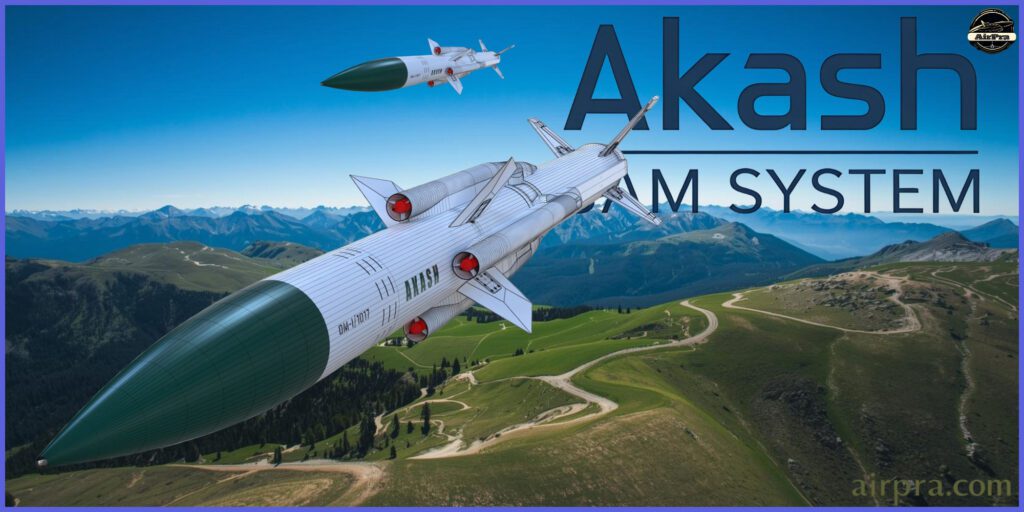
The project was led by Prahlada Ramarao, the chief designer who helped shape the overall concept of this surface-to-air missile. Akash has a distinct design but shares some similarities with the Soviet 2K12 Kub, especially its four long ramjet air inlets placed mid-body between the wings, giving it a powerful and recognisable appearance.

The Akash missile features four clipped triangular wings at its mid-body, which provide pitch and yaw control, while four inline clipped delta fins with ailerons, positioned just ahead of the tail, manage roll control.
Inside, the missile houses a sophisticated setup including a digital onboard computer, specialised propellant, modern actuators, and a command guidance system with data links. It is also fitted with a radio proximity fuse.
A single Akash fire unit can track and engage up to four targets simultaneously, achieving a maximum range of around 30 km under command guidance.

At the heart of Akash’s production lies Bharat Electronics Limited (BEL), Bangalore, the nodal production agency driving the entire weapon system and powering its cutting-edge radar technology.
But BEL isn’t alone—this formidable defence ecosystem includes Bharat Dynamics Limited, crafting the missile itself; Larsen & Toubro, contributing to both missile and launcher systems; Electronics Corporation of India Limited, building the brain of the system—the Command and Control Centre; and Tata Power Company Limited, responsible for delivering the powerful mobile launchers. Together, these industry giants bring the Akash SAM system to life.

As of 2008, the cost of each Akash missile was estimated at under ₹2 crore, which translates to roughly ₹5.6 crore or US $660,000 in 2023 terms. This made it less than half the price of comparable Western missiles, which typically cost between US$1.2–1.5 million (₹5–6 crore) per unit.
On 16 March 2016, the Director of the Defence Research and Development Laboratory (DRDL) announced plans to double the production rate, increasing from 50–60 missiles per month to 100, to meet India’s expanding defence requirements.

From Detection to Neutralisation: How the Akash System Works
Akash Battery Configurations
An Akash battery is a complete firing unit designed to detect, track, and destroy multiple aerial threats. It features advanced automated functionality. The 3D Central Acquisition Radar (CAR) begins tracking targets automatically at a range of around 150 km, providing early warning to both the system and its operators.
Each Akash battery consists of four self-propelled launchers, each carrying three Akash SAMs, a Battery-Level Radar (Rajendra), and a Command Post known as the Battery Control Centre (BCC). In the Air Force configuration, two batteries form a squadron, whereas in the Army configuration, up to four batteries comprise an Akash Group or Regiment.

In both setups, an additional Group Control Centre (GCC) is included, serving as the Command and Control Headquarters for the squadron or group. Mounted on a single mobile platform, the GCC links with all Battery Control Centres and manages air defence operations in coordination with the wider air defence network in the operational zone.
For effective early warning and threat detection, the Ground Control Centre (GCC) relies on the Central Acquisition Radar, which provides comprehensive surveillance over a wide area. In addition to this, each missile battery can be equipped with the more cost-effective 2D Battery Surveillance Radar (BSR).
This radar system, while simpler than the central unit, is highly capable and offers a detection range exceeding 100 km, allowing each battery to independently monitor and track potential aerial threats with precision and reliability.
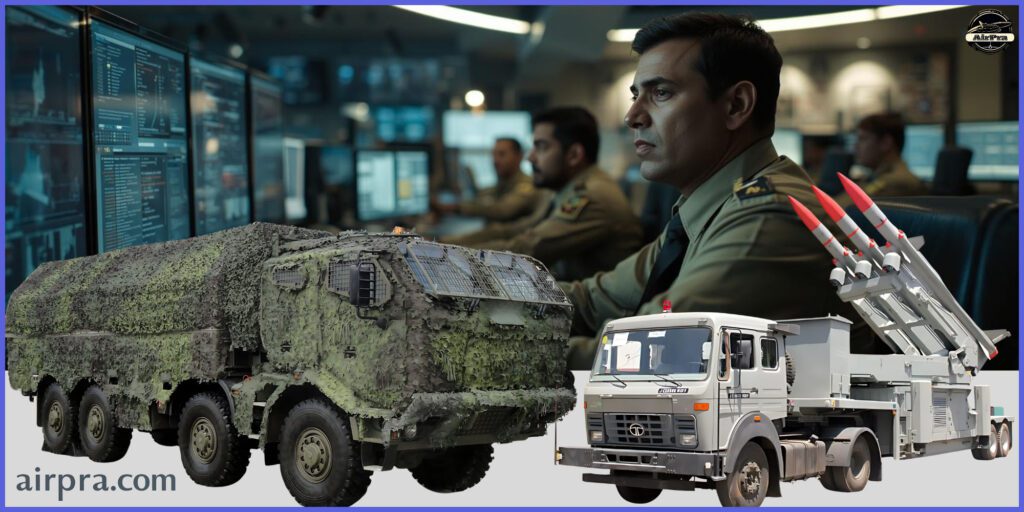
Each Akash battery is capable of engaging up to four targets simultaneously with a total of 24 ready-to-fire missiles. A single battery consists of four launchers, each carrying three missiles. The Rajendra radar can guide up to eight missiles at once, with a maximum of two missiles per target.
Therefore, a typical battery using one Rajendra radar can engage up to four targets simultaneously, depending on whether one or two missiles are assigned per target. A single Akash missile has a probability of kill (Pk) of 88%, which increases to 98.5% when two missiles are launched five seconds apart.
For seamless coordination and control, communications between various vehicles within the battery are maintained through a combination of wireless and wired links.

Akash Missile Specifications and Capabilities
The Akash is a powerful surface-to-air missile capable of intercepting targets over 30 km away. Weighing 720 kg (1,588 lb) at launch, it measures 5.78 meters in length with a 35 cm (14 in) diameter. Flying at blistering supersonic speeds of up to Mach 2.5, the missile can engage threats at altitudes as high as 20 km (66,000 ft).
Its advanced onboard guidance system, paired with responsive actuators, allows it to withstand up to 15g forces and execute sharp tail-chase manoeuvres for high-speed, endgame interceptions. Akash can be launched from both tracked and wheeled platforms, offering unmatched battlefield flexibility.
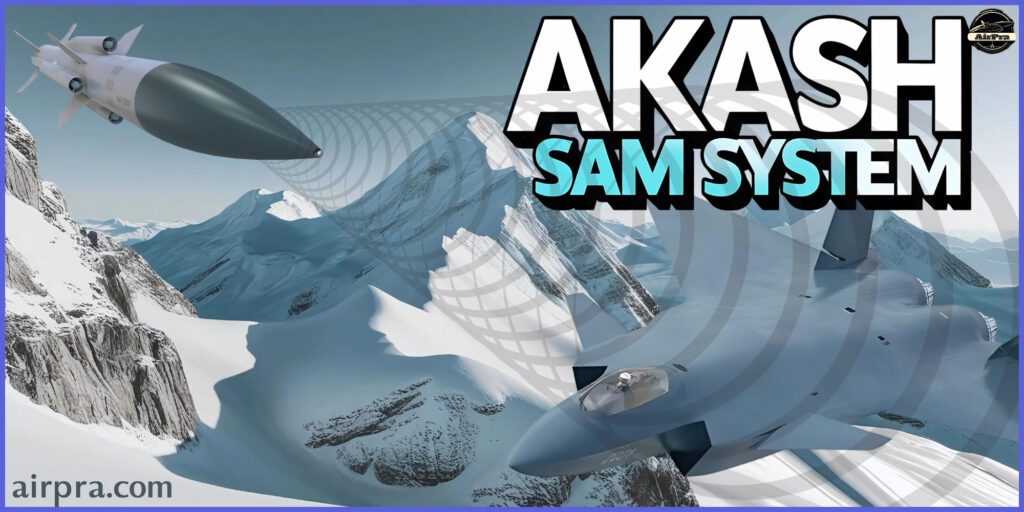
The missile is equipped with a digital radio proximity fuse paired with a 55 kg (121 lb) pre-fragmented warhead. Its safety, arming, and detonation mechanisms ensure a precise and controlled explosion.
A self-destruct system is also integrated for enhanced safety. Akash is powered by an integrated ramjet-rocket propulsion system, which activates after the initial rocket booster burns out.
This ramjet engine allows the missile to maintain a consistent supersonic speed throughout its flight. Guided by command inputs for most of its trajectory, the missile automatically switches to active radar homing in the terminal phase for accurate target engagement.

Variants of the Akash Weapon System (AWS)
The first production model of the Akash system is designated as Akash Mk1.
The Akash Mk1S was developed as an intermediate upgrade during the development of Akash Prime. It retains the original command guidance system of Mk1 while incorporating an indigenous active radio frequency seeker, significantly enhancing its ability to engage advanced targets with a higher single-shot kill probability.

Building on similar capabilities, the next variant—Akash Prime—features an active radio frequency seeker that enables 360° engagement with greater accuracy. It is specifically optimised for low-temperature and high-altitude operations, supported by a modified ground system.
Its reduced footprint offers a tactical advantage, making it harder to detect and target, thereby enhancing survivability in hostile environments.

The latest variant, introduced with a completely new design as of 2026, is the Akash-NG (New Generation), developed to succeed the Akash-1 and Akash-1S with significantly enhanced capabilities. Akash-NG features improved reaction time and better protection against saturation attacks.
It is powered by a dual-pulse solid rocket motor, extending its range to 70–80 km. The system also includes an active electronically scanned array (AESA) multi-function radar (MFR) and an optical proximity fuse for more precise detonation.

A Quick Message to Our Readers
Some details in our articles may change over time. For the most accurate and up-to-date information, we recommend consulting additional sources.
We’re passionate about providing you with trusted insights into military systems and global developments. Your support helps us continue this work. When you purchase through our affiliate links, you’re helping us grow while receiving high-quality products in return.
Your thoughts matter to us. If there’s a topic or defence system you’d like to learn more about, let us know in the comments—we’ll do our best to cover it. Thank you for being part of our journey. We appreciate your time and interest—happy reading!